
Artificial intelligence (AI) in regulatory writing refers to the use of generative AI and natural language processing to support the drafting, consistency checking, and quality control (QC) of regulatory documents such as clinical study reports (CSRs), protocols, investigator’s brochures (IBs), common technical document (CTD) summaries, and clinical evaluation reports (CERs). Although AI can speed up drafting, qualified human professionals must retain responsibility for verifying accuracy, interpreting content, and providing final sign-off. The use of AI for document authoring has the potential to substantially reduce the time between the completion of a clinical trial and regulatory submission, with generative pre-trained transformer (GPT) models emerging as a promising solution. Frameworks for GPT-based drafting of regulatory documents have already been proposed; however, significant challenges remain. Given the critical role of accuracy in regulatory documentation, GPT outputs must be carefully reviewed to identify potentially misleading or fabricated information. Another major limitation is the availability of high-quality training datasets, as comprehensive collections of clinical protocols, study results, and final regulatory reports are often difficult to access and curate for model development (Kanakia A et al., 2025). CSRs are regulatory documents that summarize clinical study findings and commonly include efficacy and safety data, alongside pharmacokinetic results. A generative AI approach using a hierarchical large language model (LLM) framework with in-context learning was developed to support the drafting of pharmacokinetic results sections directly from study tables, listings, and figures (TLFs), with expert-guided refinement. Unlike traditional fine-tuning methods, this approach requires only a small number of reports and modest computational resources while producing outputs that align with established CSR structure and writing conventions (Samuelsson et al., 2026).
Medical device organizations have established clinical evaluation processes requiring extensive documentation. However, their primary challenge is not creating a clinical evaluation report (CER) from scratch, but maintaining relevance with current literature, clinical data, and postmarketing evidence. Maintaining a CER requires identifying relevant updates, assessing their impact on existing conclusions, and revising documentation accordingly, which can be resource-intensive when evidence evolves rapidly (EU regulation 2017/745). AI can streamline this process by efficiently identifying, organizing, and comparing new information, supporting review and update activities (EMA principles, 2024). However, qualified regulatory professionals remain responsible for determining the relevance, regulatory significance, and required actions based on new evidence (FDA-EMA principles, 2026). Therefore, AI and human expertise will play complementary roles; AI will reduce the burden of information management, while human judgment will uphold the scientific integrity and ensure regulatory compliance. In a systematic analysis of European Medicines Agency (EMA) regulatory advice and public reports, the relatively limited discussion of AI use in regulatory documents may reflect two factors: the time lag between scientific advances and their application in regulatory settings, and the selective scope of the documents included in the analysis. Since advanced AI methods are still emerging, considerable time may pass between scientific developments, their adoption in real-world scenarios, and subsequent reporting in public reports (Nollen LM et al., 2026).
What is AI in regulatory writing?
AI in regulatory writing is the use of artificial intelligence to support the drafting, review, and QC of documents submitted to health authorities. AI, particularly natural language processing (NLP), is increasingly being applied in pharmaceutical regulatory affairs to support regulatory data management, document authoring, pharmacovigilance, and predictive analytics. While AI offers opportunities to improve efficiency and consistency, its implementation requires careful management of challenges such as data validation, statistical accuracy, cybersecurity, traceability, and regulatory compliance, with appropriate human oversight and accountability (Lucas et al., 2026). AI can significantly accelerate the drafting of regulatory documents, including CSRs, protocols, IBs, submission summaries, and CERs. However, qualified human professionals must retain final accountability for the accuracy, regulatory compliance, and inspection readiness of the documents (Ramachandran R et al., 2024).
How is regulatory writing different from other forms of medical writing
Medical writing encompasses a broad range of scientific and educational content for diverse stakeholders, including regulatory writing, which focuses on preparing compliant, approval-focused documents for health authorities in standardized formats, with full traceability to source data. Regulatory writing is a specialized area of medical writing that focuses on developing evidence-based documents for health authorities to support the development, approval, and ongoing monitoring of medical products. Unlike the other forms of medical writing, it requires adherence to regulatory guidelines and standardized formats, accurate integration of data from multiple sources, and consistency and traceability across documents. Regulatory writers must therefore combine scientific communication expertise with knowledge of regulatory requirements, product development, data analysis and interpretation, document review, and submission standards (Sharma S et al., 2010).
Where can AI help across regulatory documents?
AI is most helpful for repetitive, data-to-text, and consistency-checking tasks in regulatory documents. The table below summarizes what AI can assist with, and what humans must own, for each document type.
| Document | AI-assisted tasks | Human-owned tasks |
| Clinical trial protocol | Literature review, template-based drafting, consistency checks, study design figures and diagrams, and CRF template development | Scientific rigor, regulatory compliance, and patient safety |
| CSR | Narrative drafting, synopsis generation, data summarization from TFLs, and consistency checks against the protocol and SAP | Verification of all outputs against source data by qualified reviewers |
| IB | Literature updates, data summaries, and consistency in formatting and content | Scientific interpretation and final approval |
| CTD module summaries | Data extraction, evidence synthesis, draft generation, and cross-document consistency checks | Scientific interpretation, regulatory strategy, and final sign-off |
| CER (devices) | Literature review, evidence extraction, data summarization, and cross-document consistency checks | Scientific interpretation, clinical evaluation, regulatory compliance, and final sign-off |
Details by document type:
- Clinical trial protocols outline a study’s objectives, design, methodology, eligibility criteria, and endpoints. AI can streamline protocol development through literature reviews, template-based drafting, consistency checks, and the creation of necessary figures and diagrams of the study design. Additionally, based on the variables specified in the protocol, AI can be utilized for the development of the case report form (CRF) template before data collection. However, expert oversight is essential to ensure scientific rigor, regulatory compliance, and patient safety.
- CSRs provide a comprehensive summary of trial conduct, efficacy results, and safety outcomes. AI can support narrative drafting, synopsis generation, data summarization from TFLs, and consistency checks against the protocol and statistical analysis plan (SAP). However, all outputs must be verified by qualified reviewers against the source data. For a detailed walkthrough, see our guide to CSRs.
- IBs compile the clinical and nonclinical evidence supporting an investigational product. AI can assist with literature updates, data summaries, and formatting and content consistency, while scientific interpretation and final approval remain the responsibility of subject-matter experts (Barucci A et al., 2026).
- CTD module summaries can be developed usingAI by enabling data extraction, evidence synthesis, draft generation, and consistency checks across regulatory documents. AI can also contribute to the organization and strategic presentation of information. This helps streamline the preparation of clinical overviews, clinical summaries, nonclinical overviews, and quality overall summaries, while expert regulatory writers retain responsibility for scientific interpretation, regulatory strategy, and final sign-off (Lucas I et al., 2026). Also check our overview of CTD.
- CER (devices) development can be supported by AI by facilitating literature reviews, evidence extraction, data summarization, cross-document consistency checks, thus enabling compilation of clinical evidence. Further, human oversight of scientific interpretation, clinical evaluation, regulatory compliance, and final sign-off are required (Lucas I et al., 2026). Read more in our post on CERs for medical devices.
Where does AI create risk in regulatory documents?
The main risks of AI in regulatory documents are hallucinated content, data mismatches with source documents, weak traceability and audit trails, unvalidated tools, and exposure of confidential trial data. AI may generate plausible-looking but inaccurate citations, data points, or conclusions, potentially leading to data integrity issues and regulatory noncompliance unless rigorously verified by human reviewers. It may also inaccurately transfer or summarize data from source and external documents, leading to incorrect values, discrepancies between tables and narratives, and potential regulatory compliance issues if not independently verified. AI-generated content may lack sufficient traceability regarding source data, prompts, and document revisions, making it difficult to verify content, support QC activities, and demonstrate regulatory compliance during inspections. AI tools that have not been formally validated may produce unreliable or unreproducible outputs with missing audit trails, increasing the risk of errors in regulatory documents. Using unapproved or public AI tools with confidential clinical trial data can also expose unpublished information and breach sponsor agreements and data privacy requirements.
What are regulators saying about AI?
Regulators have not prohibited AI-assisted regulatory writing, but they expect scientific accuracy, data integrity, transparency, and human accountability. Regulatory experts emphasize that AI implementation should be supported by transparent governance frameworks, rigorous validation, and human oversight. Measures to address safety, privacy, bias, and accountability concerns should also be incorporated to promote trustworthy and responsible use of AI in healthcare (Pantanowitz L et al., 2024).
The frameworks listed below reinforce the importance of scientific accuracy, data integrity, and human accountability:
| References | Key considerations for medical writers |
| International Council for Harmonisation of Technical Requirements for Pharmaceuticals for Human Use (ICH) E3 (EMA: ICH E3) CPMP/ICH/137/95 | Maintain CSR structure, accuracy, and consistency with clinical study data. |
| ICH M4 (ICH: CTD) | Ensure correct CTD organization, cross-module consistency, and submission readiness. |
| EU AI Act (Regulation (EU) 2024/1689) | Understand AI risk classification, accountability, transparency, and applicable compliance requirements |
| Food and Drug Administration (FDA) draft guidance on AI to support regulatory decision-making (January 2025) | Establish AI model credibility in relation to its intended context of use when supporting regulatory decisions |
| AI in medicinal product lifecycle reflection paper (2023) | Apply responsible AI practices, as AI-generated outputs should be reliable, traceable, and appropriately validated |
What does a human-verified regulatory workflow look like?
A human-verified regulatory workflow keeps qualified professionals in control of every AI-assisted step, from source input to regulatory submission. The sequence is:
- Source input: anonymized data and approved templates, as per the sponsor agreement
- AI first draft: generated in an organization-approved tool
- Regulatory writer review: data are cross-checked against source documents, and AI-generated content is combined with written content
- Regulatory expert and statistician review: review of statistical analysis and content by subject-matter experts
- QC sign-off: with an audit trail
- Client delivery and regulatory submission
Any discrepancy, correction, or data mismatch is resolved before the document moves to the next step.
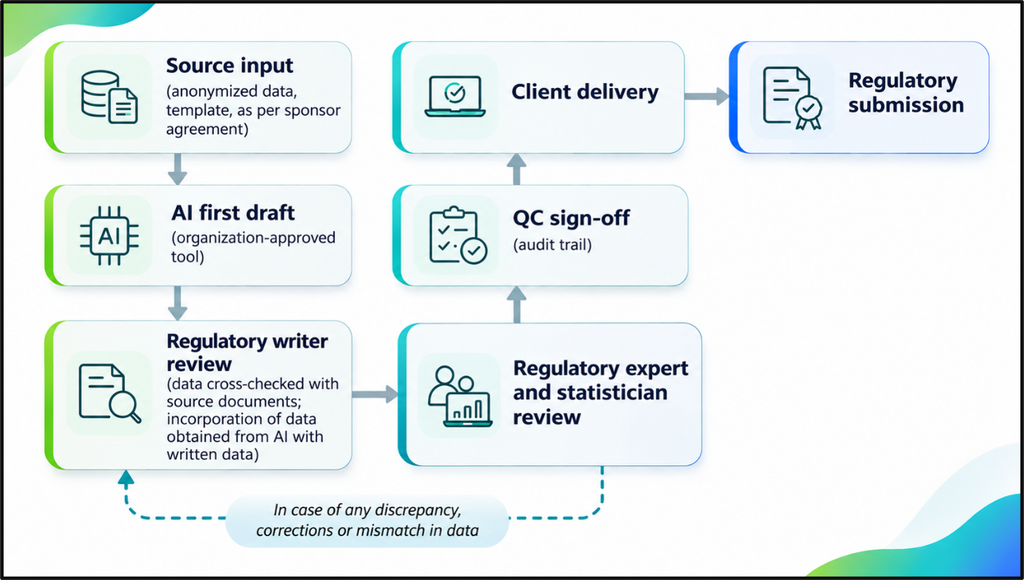
Figure 1: Human-verified regulatory writing workflow from source input and AI first draft to regulatory review, QC sign-off, and submission.
A human-verified regulatory workflow involves the review, validation, and approval of AI-generated content by qualified regulatory professionals before it is used in regulatory submissions or decision-making. This review ensures scientific accuracy, regulatory compliance, traceability, and accountability, while mitigating risks associated with automated content generation (Lucas et al., 2026). AI-generated content should be based exclusively on approved, traceable source materials, allowing every statement and conclusion to be linked back to validated evidence. AI can assist with preparing initial drafts by using structured source data and standardized regulatory templates, thereby enhancing consistency and improving document development efficiency.
All numerical data, including efficacy outcomes and safety findings generated by AI, should be rigorously verified against the original TFLs and reviewed by a statistician to ensure accuracy and minimize the risk of errors or hallucinated information. The final review and authorization of regulatory documents should be conducted by qualified regulatory writers, subject matter experts, or quality reviewers who are accountable for the submission’s scientific integrity and compliance (Meyer C et al., 2023). Regulatory teams should review content across related documents, such as protocols, SAPs, CSRs, IBs, and CTD summaries, to ensure consistency in key messages and data presentation. Organizations should maintain records of how AI was used, the level of human oversight applied, and the validation procedures performed to support transparency and regulatory compliance (Eser et al., 2025). For the full governance approach that we apply across medical writing and publications, see our human-verified AI protocol.
Frequently asked questions about AI in regulatory writing
- Can AI write a CSR?
Not on its own. AI can support the preparation of a CSR in alignment with the ICH E3 structure by transforming data into narrative content. However, all AI-generated outputs should undergo rigorous expert review and quality assurance before being incorporated into regulatory submissions (Meyer C et al., 2023).
2. Is AI-generated content acceptable in regulatory submissions?
AI-generated content can be used in regulatory submissions, provided it is accurate, traceable, scientifically justified, and appropriately validated by qualified personnel. Its use must comply with applicable regulatory guidance, including relevant FDA and EMA recommendations, and the sponsor remains accountable for the integrity of the submitted information (Meyer C et al., 2023).
3. How do you protect confidential trial data when using AI?
At Turacoz, we use only organization-approved, secure AI platforms with appropriate data protection, access controls, and contractual safeguards to prevent confidential information from being exposed or used for third-party model training. Patient-identifiable information is deidentified wherever feasible, and confidential trial data are processed only through authorized workflows, with appropriate human oversight and adherence to sponsor agreements and applicable data privacy requirements.
4. Does AI replace regulatory medical writers?
No. At Turacoz, AI is intended to augment regulatory medical writers, not replace them, by automating repetitive tasks, supporting literature and data review, and improving drafting efficiency. Regulatory writers remain essential for scientific interpretation, critical thinking, regulatory judgment, quality oversight, and ensuring document integrity and accuracy (Umut Eser et al., 2025).
5. What should be disclosed?
The use of AI should be transparently disclosed to clients and relevant stakeholders, including the AI tools used, the nature and extent of their involvement, and the activities supported by AI. Any disclosure should also clarify the human review, verification, and QC processes undertaken, in accordance with sponsor agreements, organizational policies, and applicable regulatory requirements.
6. Can AI help with a CER?
Yes, AI can support the preparation of a CER by assisting with literature searches, evidence extraction, clinical data summarization, identification of safety and performance trends, and document drafting. However, clinical relevance, evidence quality, benefit-risk assessments, and conclusions must be critically evaluated and validated by qualified clinical and regulatory experts to ensure compliance with applicable requirements, particularly the EU medical device regulation (MDR) (Lucas et al., 2026).
7.Work with Turacoz’s regulatory writing team
Planning a regulatory submission and want the speed of AI without compromising accuracy or compliance? Talk to our regulatory writing team to see how our human-verified workflow works in practice.
REFERENCES
- Kanakia A, Sale M, Zhao L, Zhou Z. AI in action: redefining drug discovery and development. Clin Transl Sci. 2025;18(2):e70149. doi:10.1111/cts.70149.
- Samuelsson J, Blakeman S, Alexander E, et al. A generative AI framework for pharmacokinetic clinical study report authoring. Clin Transl Sci. 2026;19(6):e70644. doi:10.1111/cts.70644.
- European Parliament and Council of the European Union. Regulation (EU) 2017/745 of the European Parliament and of the Council of 5 April 2017 on medical devices. Off J Eur Union. 2017;L117:1-175. Accessed November 27, 2026. https://eur-lex.europa.eu/eli/reg/2017/745/oj.
- US Food and Drug Administration. Guiding principles of good AI practice in drug development. Published January 2026. Accessed November 27, 2026. https://www.fda.gov/about-fda/artificial-intelligence-drug-development/guiding-principles-good-ai-practice-drug-development.
- Lucas I, Sousa J, Vitorino C. Artificial intelligence in pharmaceutical regulatory science: opportunities, challenges, and emerging frameworks. AAPS J. 2026;28(6):156. doi:10.1208/s12248-026-01283-2.
- Meyer C, Adkins D, Pal K, Galici R, Garcia-Agundez A, Eickhoff C. Neural text generation in regulatory medical writing. Front Pharmacol. 2023;14:1086913. doi:10.3389/fphar.2023.1086913.
- Barucci A, Colcelli V, De Masi S, et al. Ethical and regulatory frameworks for artificial intelligence in clinical research: a European perspective on the Artificial Intelligence Act for ethics committees and researchers. Eur Cardiol. 2026;21:e01. doi:10.15420/ecr.2025.59.
- Ramachandran R, Linenbach T, Ceppi C, Modi A. Reimagining clinical and regulatory medical writing with generative AI. AMWA J. 2024;39(2). doi:10.55752/amwa.2024.335.
- Pantanowitz L, Hanna M, Pantanowitz J, et al. Regulatory aspects of artificial intelligence and machine learning. Mod Pathol. 2024;37(12):100609. doi:10.1016/j.modpat.2024.100609.
- Eser U, Gozin Y, Stallons LJ, et al. Human-AI collaboration increases efficiency in regulatory writing. arXiv. Preprint posted online September 2025. doi:10.48550/arXiv.2509.09738.
- Nollen LM, van Westen GJP, Westman G, Pasmooij AMG. Artificial intelligence for regulatory evidence: a systematic document analysis of European Medicines Agency regulatory advice and public reports. Clin Pharmacol Ther. 2026;120(1):224-235. doi:10.1002/cpt.70300.
- Sharma S. How to become a competent medical writer? Perspect Clin Res. 2010;1(1):33-37.
AUTHOR
Shruti Kadam & Isha Bhat