Client: A pharmaceutical company (anonymized for client confidentiality)
Product: Fixed-dose combination (FDC) containing three active pharmaceutical ingredients (APIs)
Market and regulator: Australia, Therapeutic Goods Administration (TGA)
Scope: Common Technical Document (CTD) Module 1.5 (Literature Search Methodology), Module 2.5 (Clinical Overview), Module 2.7 (Clinical Summary), and Module 5 (Clinical Study Reports and supporting clinical evidence)
Core challenge: Minimal to no direct clinical evidence for the complete combination in the intended patient population
Approach: Targeted literature search, critical evaluation of indirect evidence, and evidence-graded regulatory writing
Databases: PubMed, Google Scholar, Ovid
Outcome: Complete CTD documentation across all four sections, aligned with the applicable Therapeutic Goods Administration (TGA) requirements
Developing a regulatory dossier for a pharmaceutical product requires a comprehensive understanding of the available clinical evidence, its relevance to the proposed product, and its ability to support regulatory requirements. The Common Technical Document (CTD) is the internationally harmonized format used to organize the quality, nonclinical, and clinical sections of a medicinal product registration dossier.
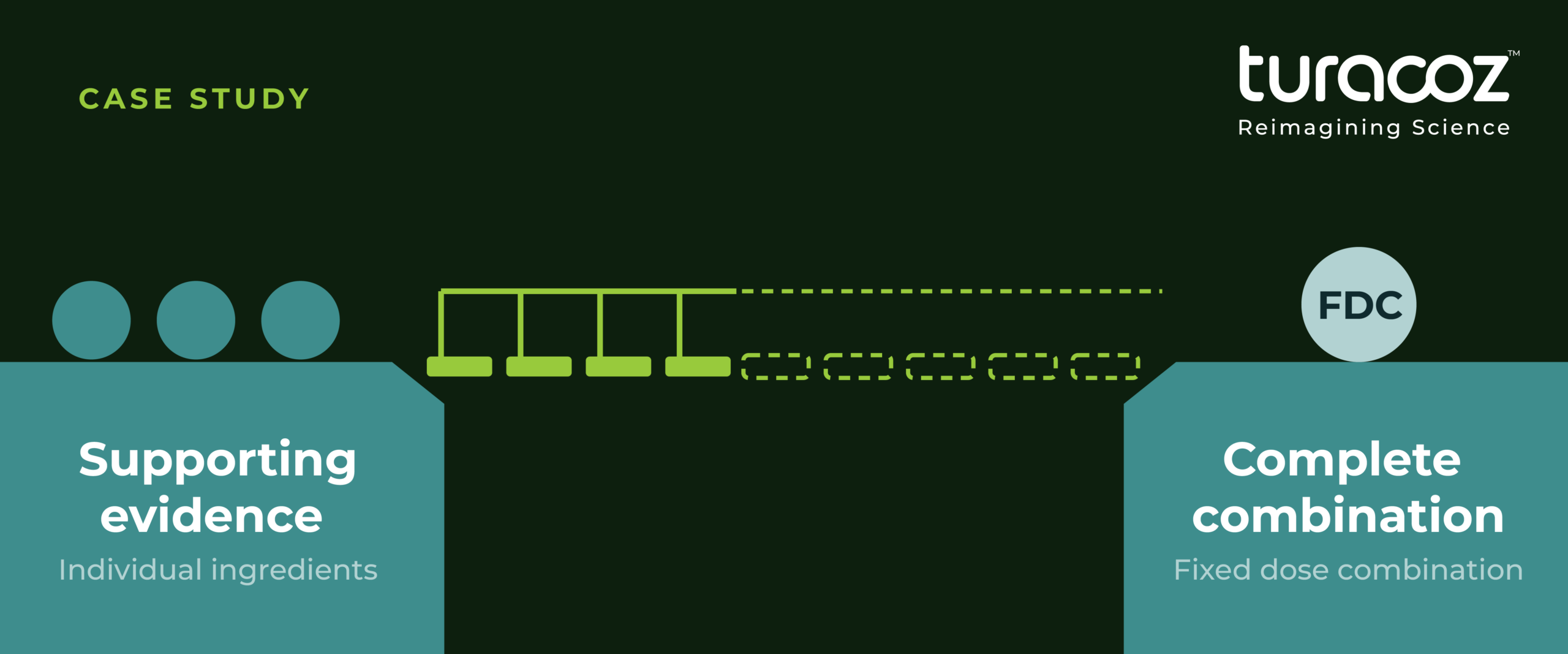
Turacoz supported a pharmaceutical client in developing four key sections of the CTD for a fixed-dose combination (FDC) product. This product contained three active pharmaceutical ingredients (APIs) and was intended for marketing in Australia. The scope included Module 1.5 (Literature Search Methodology), Module 2.5 (Clinical Overview), Module 2.7 (Clinical Summary), and Module 5 (Clinical Study Reports and supporting clinical evidence), in accordance with the applicable Australian Therapeutic Goods Administration (TGA) requirements.
However, the project presented a significant scientific challenge: there was minimal to no direct clinical evidence supporting the complete combination in the intended patient population. This created a substantial evidence gap that had to be addressed to support the development of a scientifically robust regulatory dossier.
To address the challenge, Turacoz adopted a structured, literature-driven approach combining a comprehensive literature review, critical scientific appraisal, and regulatory-focused medical writing.
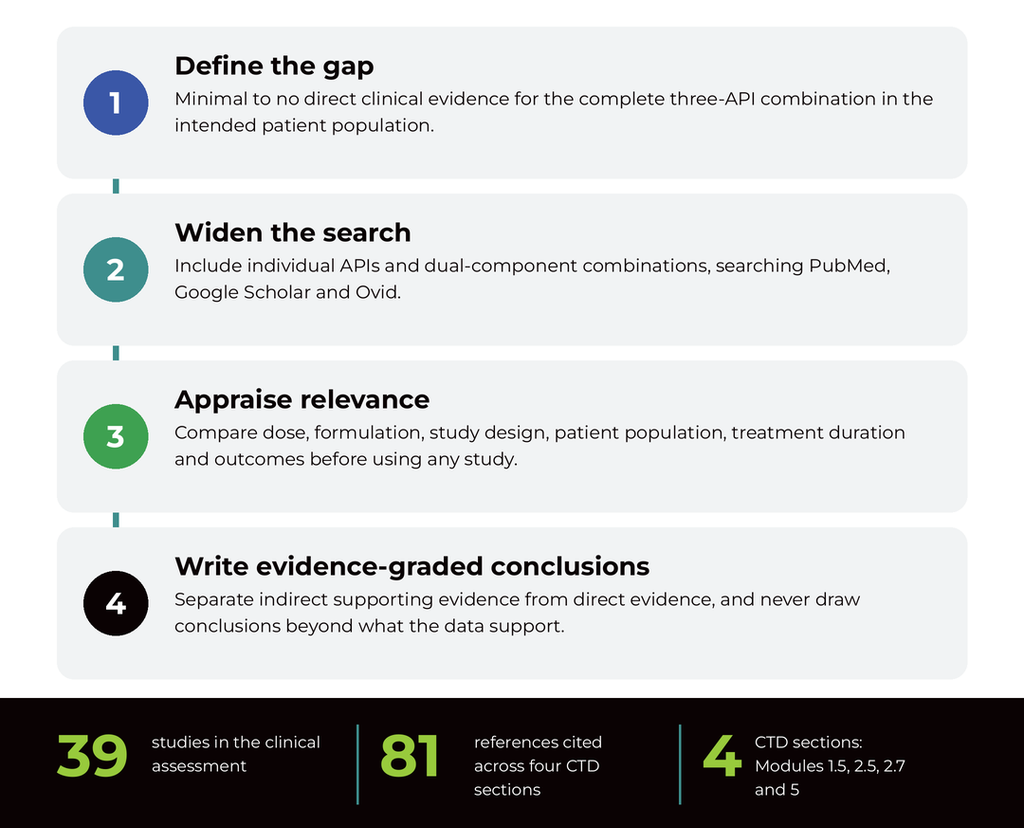
A targeted literature search strategy was developed to identify relevant clinical evidence using multiple scientific databases, including PubMed, Google Scholar, and Ovid.
Given the limited availability of studies evaluating the complete FDC, the search strategy was expanded to capture evidence relating to individual APIs and dual-component combinations. This broader evidence retrieval strategy enabled the team to establish a comprehensive scientific foundation for the subsequent CTD sections.
One of the most technically demanding aspects of the project was establishing a scientific rationale for the proposed FDC using evidence from individual ingredients and dual-component combinations.
We systematically evaluated the available studies and considered differences in dosage, formulation, study design, patient population, treatment duration, and clinical outcomes. Rather than assuming that findings from individual ingredients or other combinations could be directly applied to the proposed FDC, we critically assessed their relevance and applicability to the evaluation of its clinical and pharmacological profile.
The objective was to develop a scientifically justified assessment while clearly distinguishing available supporting evidence from direct clinical evidence for the complete combination.
Developing Modules 2.5 and 2.7 was particularly challenging because the available evidence originated from studies with varying methodologies, doses, formulations, populations, and outcome measures.
The task involved more than summarizing individual publications. It required integrating findings from multiple sources into a structured and logically connected clinical assessment.
We focused on:
Perhaps the most critical challenge was determining how strongly the available evidence could support the clinical conclusions. With limited direct evidence for the proposed combination, it was not always possible to draw definitive conclusions regarding efficacy and safety. Nevertheless, the regulatory documentation required a meaningful and balanced assessment of the available clinical evidence. We therefore had to strike a careful balance between presenting the scientific rationale and avoiding conclusions that extended beyond the supporting data.
This required:
This evidence-led approach helped ensure that the documentation remained scientifically credible, transparent, and appropriately qualified.
Collaboration with the client’s subject matter expert played an important role in strengthening the evidence assessment. Expert insights helped the team identify additional strategies for evidence utilization, including the consideration of safety data from higher-dose studies to support the assessment of lower-dose exposures, wherever scientifically justified. This collaborative approach broadened the evidence base and helped ensure a more comprehensive and informed evaluation of the product’s safety profile.
The project also highlighted the limitations of client-led AI-generated content for complex regulatory documentation. The AI-generated content explored by the client required substantial scientific verification, refinement, and contextualization by the Turacoz team. This reinforced the importance of expert medical writers in validating scientific claims, interpreting clinical evidence, ensuring reference accuracy, and maintaining regulatory alignment. The experience also highlighted that AI can support documentation workflows but cannot replace the critical scientific judgment required for CTD development.
Another important aspect was maintaining consistency and traceability across the different sections of the regulatory dossier.
The literature search methodology, supporting clinical publications, and clinical assessments needed to form a connected evidence framework. Turacoz systematically organized and documented the available published clinical evidence and supporting references for the relevant CTD sections, including the literature-based clinical evidence presented in Module 5, as applicable.
Through a systematic literature-based approach and extensive scientific evaluation, Turacoz developed the required CTD documentation across Modules 1.5, 2.5, 2.7, and 5 in alignment with the applicable TGA regulatory framework.
The final clinical assessment included 39 relevant studies supporting the evaluation of pharmacokinetics, pharmacodynamics , efficacy, and safety, with 81 references cited across the four CTD sections. In the absence of substantial direct clinical evidence for the complete combination, the team critically evaluated and synthesized findings from individual ingredients and dual-component combinations to develop comprehensive, structured, and evidence-based regulatory documentation.
The project demonstrated Turacoz’s ability to navigate complex regulatory medical writing assignments involving limited direct clinical evidence and to translate fragmented scientific information into a scientifically robust regulatory dossier.
This project reinforced an important principle of regulatory medical writing:
The strength of a regulatory submission is determined not by the volume of available evidence but by the quality of its evaluation, interpretation, and presentation.
At Turacoz, we combine scientific expertise, regulatory understanding, and evidence-based medical writing to address complex documentation challenges and transform fragmented clinical evidence into structured, transparent, and scientifically robust regulatory submissions.
Turacoz developed four sections of the Common Technical Document (CTD): Module 1.5 (Literature Search Methodology), Module 2.5 (Clinical Overview), Module 2.7 (Clinical Summary), and Module 5. The FDC contained three active pharmaceutical ingredients and was intended for marketing in Australia, in line with Therapeutic Goods Administration (TGA) requirements.
Widen the literature search to individual ingredients and combinations, critically appraise the relevance of each study to the proposed product, and clearly separate indirect supporting evidence from direct evidence for the complete combination. Conclusions should never go beyond what the data support.
It can contribute to the scientific rationale, but only after careful evaluation of differences in dose, formulation, study design, patient population, treatment duration, and outcomes. Findings should not be assumed to apply directly to the FDC, and the limitations should be stated openly.
AI can support documentation workflows, but AI-generated content in this project needed substantial scientific verification, refinement, and contextualization by expert medical writers. Expert judgment remains essential for validating claims, interpreting evidence, checking references, and maintaining regulatory alignment.
Planning a CTD submission with limited direct clinical evidence? Talk to the Turacoz regulatory medical writing team.

Tanvi Goel
Tanvi is a Medical Writer with 3+ years of experience in regulatory writing, scientific publications, and medical communications. She brings expertise in developing clinical and scientific content, including clinical study reports, protocols, investigator brochure’s, CTD documents, manuscripts, abstracts, and posters. Committed to scientific excellence, she focuses on translating clinical evidence into clear, credible, and meaningful scientific communication.
Client: Dr. XXX, a leading researcher in cardiovascular medicine
Turacoz, a renowned medical writing and healthcare communications company, has a strong reputation for delivering high-quality, accurate, and culturally sensitive medical

In the rapidly evolving landscape of healthcare, effective communication is paramount to drive innovation, shape strategies, and foster collaborations. Turacoz
In the dynamic landscape of pharmaceuticals and healthcare, the dissemination of clinical trial data to healthcare providers (HCPs) plays a
Client: Pharma Target Audience: Healthcare Professionals (HCPs) Overview: The eDetail Aid serves as a critical tool in pharmaceutical communication, bridging
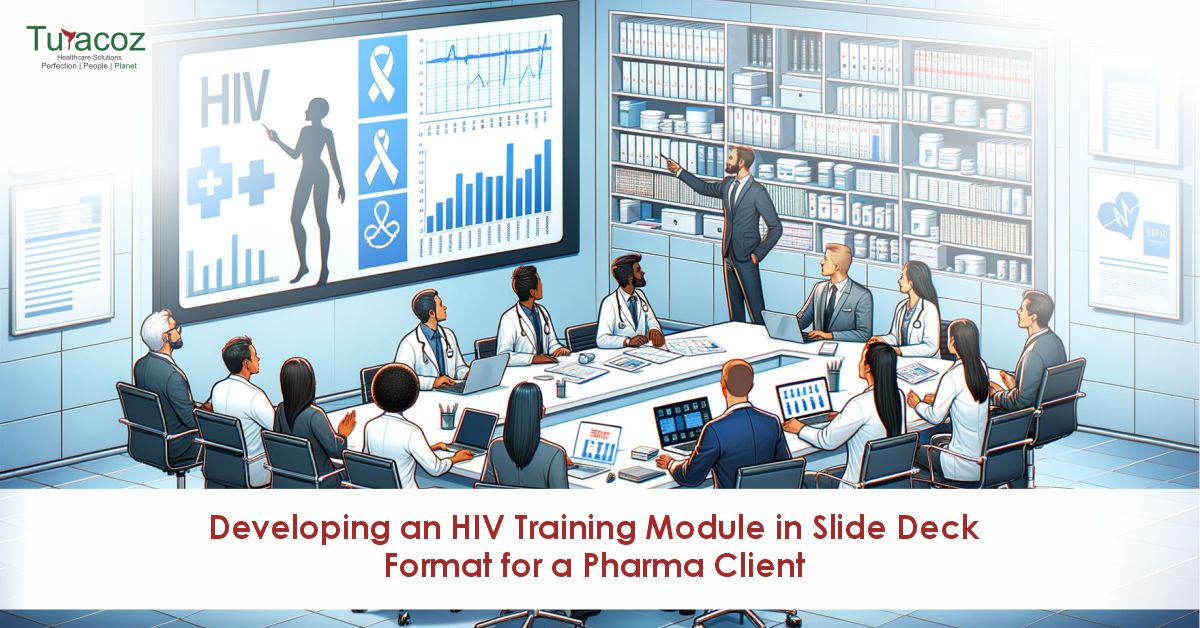
Client: Pharma Target Audience: Medical Affairs Internal Team The landscape of HIV treatment is continually evolving as new clinical studies and

Navigating the dynamic landscape of pharmaceutical marketing requires agility and innovation. Turacoz Healthcare Solutions prides itself on being at the
With the evolution of the pharmaceutical industry (Pharmaceutical Solutions), expanding into new markets presents both opportunities and challenges for companies
In the ever-evolving landscape of medical writing, challenges frequently emerge that demand innovative solutions and meticulous attention to detail. This
In response to an urgent request from a prominent pharmaceutical client, Turacoz, a leading Medical Writing Agency and Medical Communications Services provider,

In the dynamic landscape of healthcare, effective communication is paramount for disseminating critical information. This case study explores the transformative

Objective: To train and mentor the doctors on the good medical writing practices and address their publication related challenges.

Objective: To train and mentor the doctors on the good medical writing practices and address their publication related challenges.

Objective: The client approached us with a challenging project that required the development of meta-analysis on the effect of phenobarbit
Objective: The client approached us to develop the CSR for a phase 1 trial (therapeutic area: bone disorder). It was
Objective: The client (a leading pharmaceutical company) approached us with a project that required conducting a survey with the doctors.
Objective: The client specified that they required an intensive Medical Rationale Document (MRD) to be developed for a global study
Objective: The client approached us with a manuscript writing project which required drafting the manuscript, getting the same approved from
Objective: The client approached us with a challenging project that required the generation of consensus statement for prophylactic management of
Objective: A assignment required us to train a group of nephrology consultants on various key aspects of medical writing. The
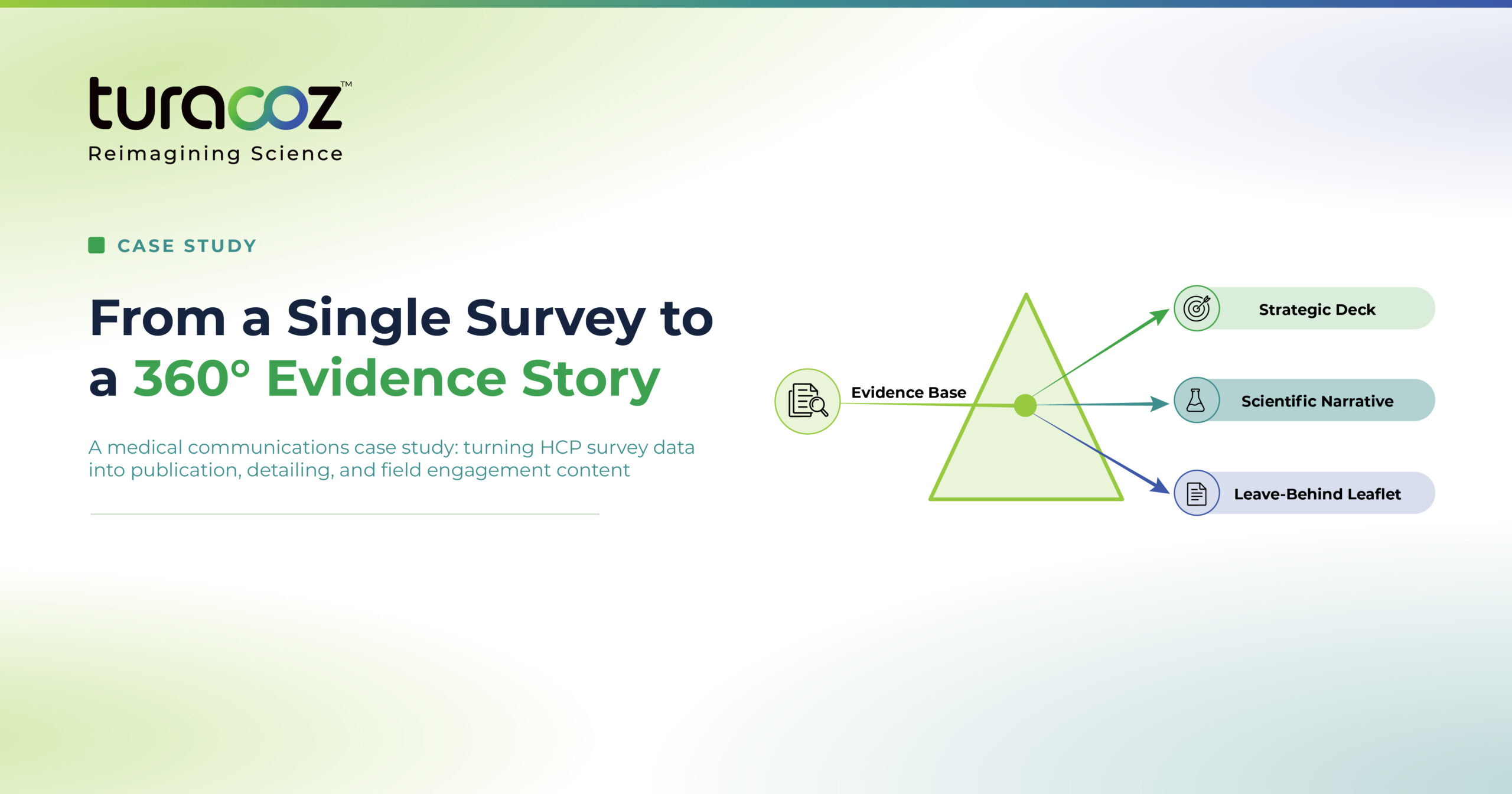
A medical communications case study: turning HCP survey data into publication, detailing, and field engagement content A leading dermatology brand
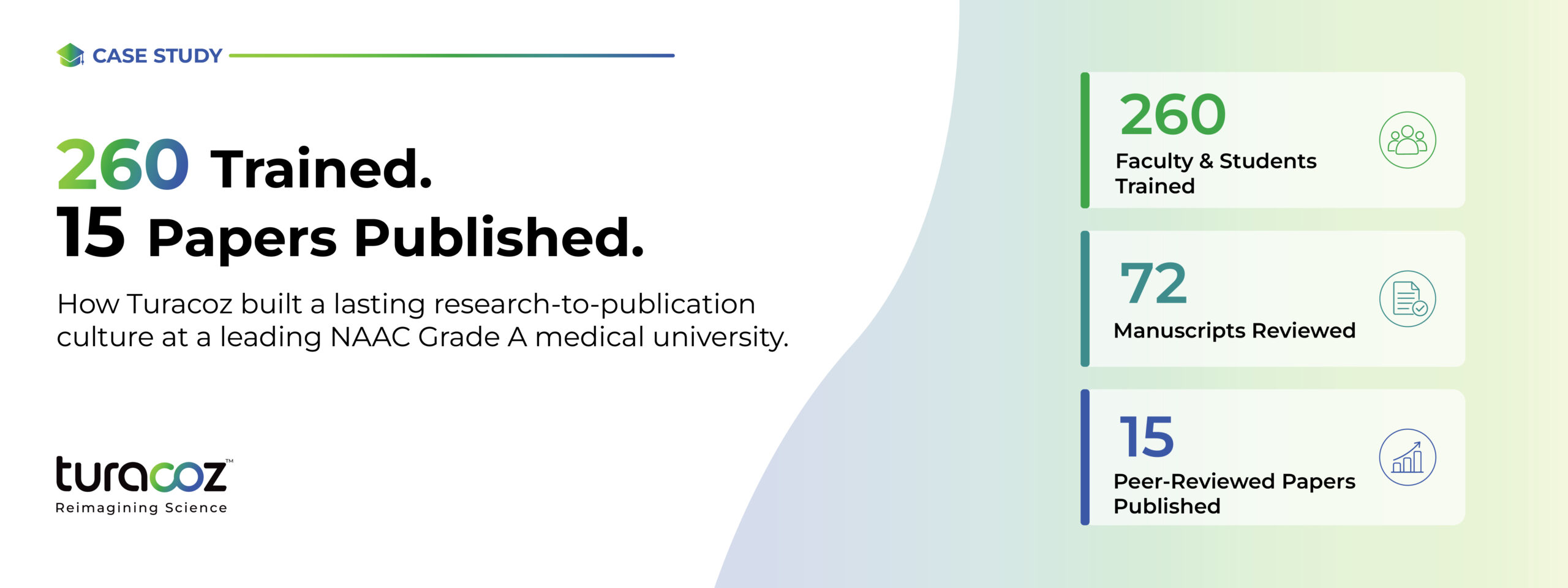
The Challenge An NAAC Grade A medical university, accredited by NABH and NMC, in Nashik approached us with a real

As influenza vaccine technologies evolved, high-dose and recombinant vaccines increasingly challenged the established role of standard-dose influenza vaccines, particularly among

At a Glance Turacoz, a global scientific communications agency, supported an international Delphi consensus on clinical trial endpoints in sickle

Partner with Turacoz to bring science to life through strategic and evidence-based communication.